The short answer
- Meeting rooms: frost from about 900 mm to 1,800 mm above the finished floor. The top edge has to clear a standing person's eye line, roughly 1,500 to 1,700 mm, or the corridor sees straight over it.
- Full privacy (HR, interviews, prayer rooms): frost from the floor to at least 2,000 mm, or full height.
- Safety marking: Dubai's Universal Design Code checklist asks for two 100 mm bands on glass, one between 850 and 1,000 mm and one between 1,400 and 1,600 mm, with a 50 LRV contrast. A 900 to 1,800 mm band covers both, if it contrasts with what is behind the glass.
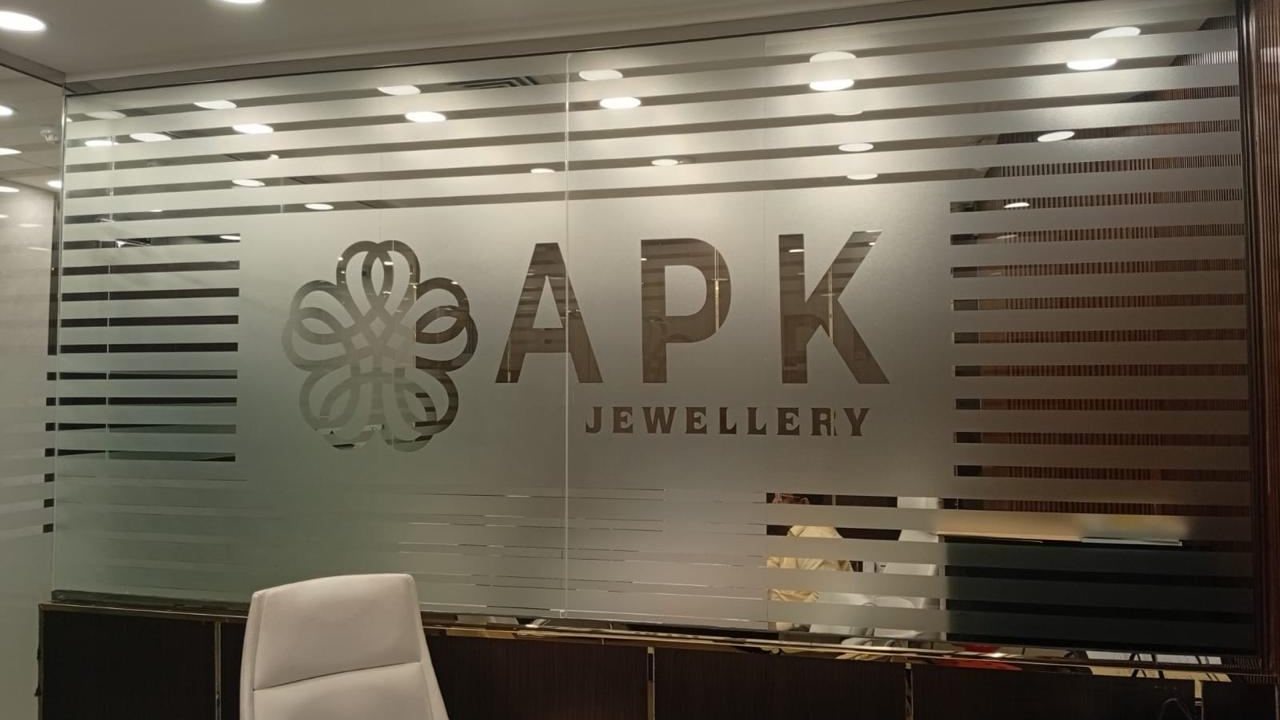
- Logos: bold shapes cut well from frosted vinyl; fine lines and small text belong on printed film.
- Frosted film blocks the view, not sound, and at night people outside see shadows, not faces.
That opening rule answers most of what clients ask us, but the details are where office glass goes wrong. A band that starts 100 mm too high lets passers-by look straight over it. A white frost in front of a white wall can fail the contrast test for safety marking. A fine logo cut into vinyl looks ragged from a metre away.
This guide is written for office managers, fit-out teams and business owners in Dubai, Sharjah and Ajman who are deciding how to frost their glass. It does not sell a package. It explains the decisions, so you can brief any installer, including us, with confidence.
A note on the numbers. The privacy heights here are practical rules of thumb based on typical adult eye levels. The safety marking heights come from published codes. Your fit-out consultant, or the authority approving your fit-out, has the final word on safety marking in your building.
Where to put the band: the height guide
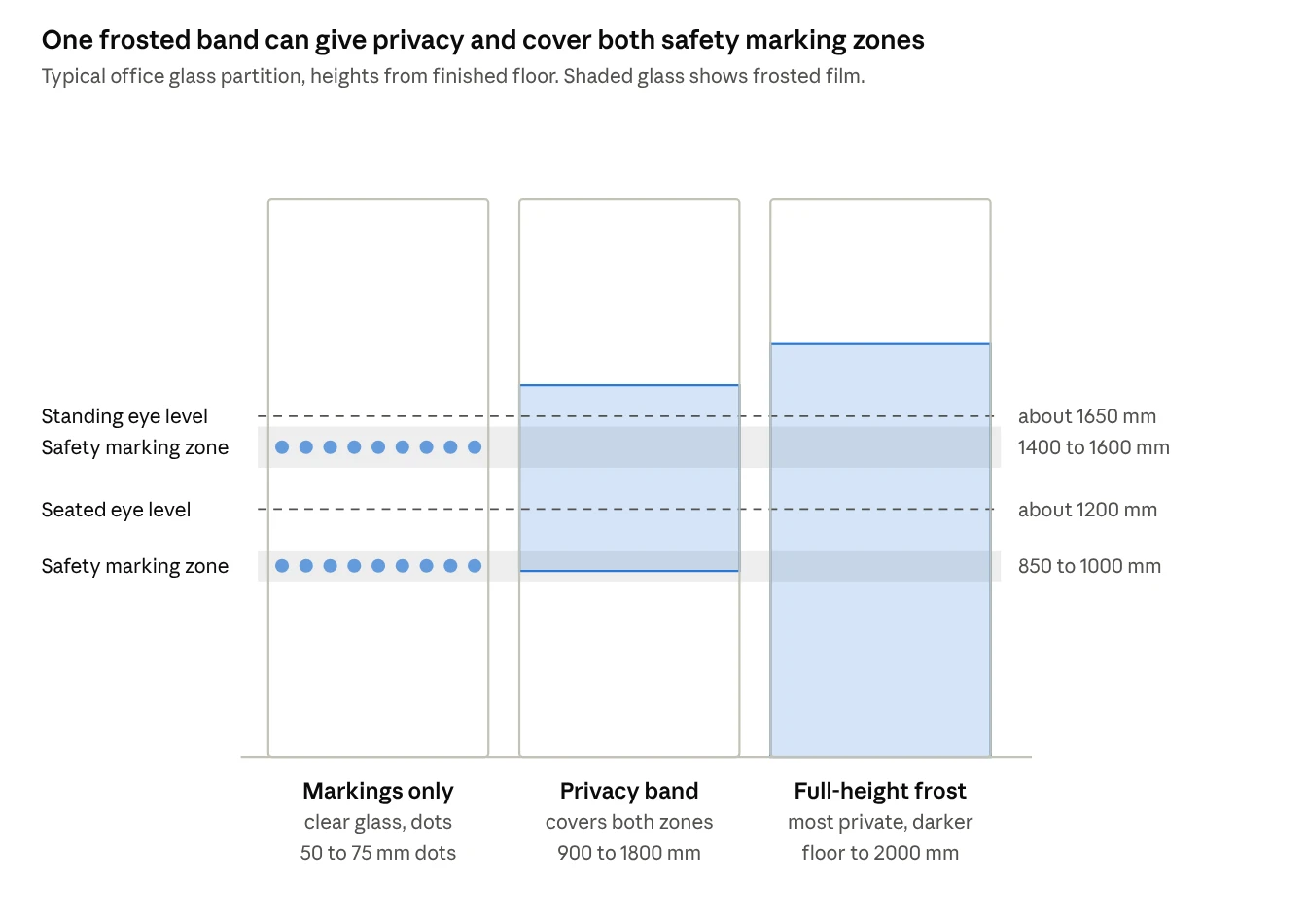
Two lines decide everything. Seated eye level is about 1,200 mm above the floor, and standing eye level is about 1,500 to 1,700 mm. People in the corridor are standing, so the top edge of the frost has to sit above their eyes. If it stops at 1,500 mm, the band feels private from your chair but is not private at all from the corridor: anyone walking past looks over it and down onto the table.
The bottom edge is about what you want to hide below the table: bags, cables, legs and the clutter under a desk. Starting around 900 mm leaves the lower glass clear, which keeps the space feeling open, lets more light through and makes the band read as a deliberate design line rather than a cover-up.
Always measure from the finished floor. On a raised access floor or thick carpet, that is a different number from the slab level shown on the drawings, and a 50 mm difference is enough to move the top edge below a tall person's eyes.
Choosing a privacy level for each room
Not every room needs the same frost. Start from what the people inside need to hide, and from whom.
| Room | What people need | Usual approach | Rough frost heights |
|---|---|---|---|
| Meeting room | Faces and screens hidden from the corridor | Privacy band | 900 to 1,800 mm |
| Manager's office | Privacy at the desk, some openness | Privacy band, or floor to 1,800 mm | 900 or floor, up to 1,800 mm |
| HR, interview or finance room | Full privacy for sensitive conversations | Full-height frost, small clear strip at the top for light | Floor to 2,000 mm, or full height |
| Prayer room or wellness room | Complete privacy | Full-height frost | Full height |
| Reception and front of house | Openness, with a brand moment | Logo, gradient or decorative strip | Within the 850 to 1,600 mm zone |
| Open-plan partitions and breakout areas | People can see the glass is there | Safety markings only | Dots or a logo strip in both marking zones |
| Server and storage rooms | Hide the contents, nothing more | Plain full frost | Full height |
Other frost types, and when they make sense:
- Half frost (floor to about 1,200 mm) hides desks and clutter but not faces. It suits open offices that want tidiness, not privacy.
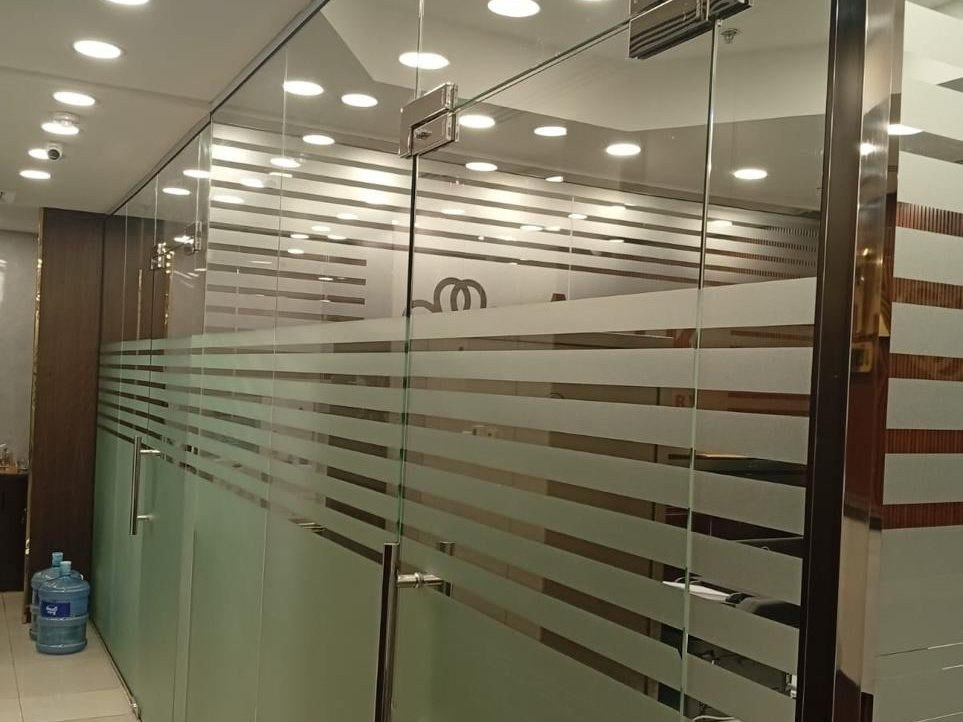
- Gradient frost runs dense at the bottom and fades out towards the top, or the other way round. It softens the view without boxing a room in, which suits receptions and executive offices.
- Striped or patterned frost uses horizontal lines or a pattern. The more of the glass that is frosted, the more private it is: thin lines with wide gaps are decoration, not privacy.
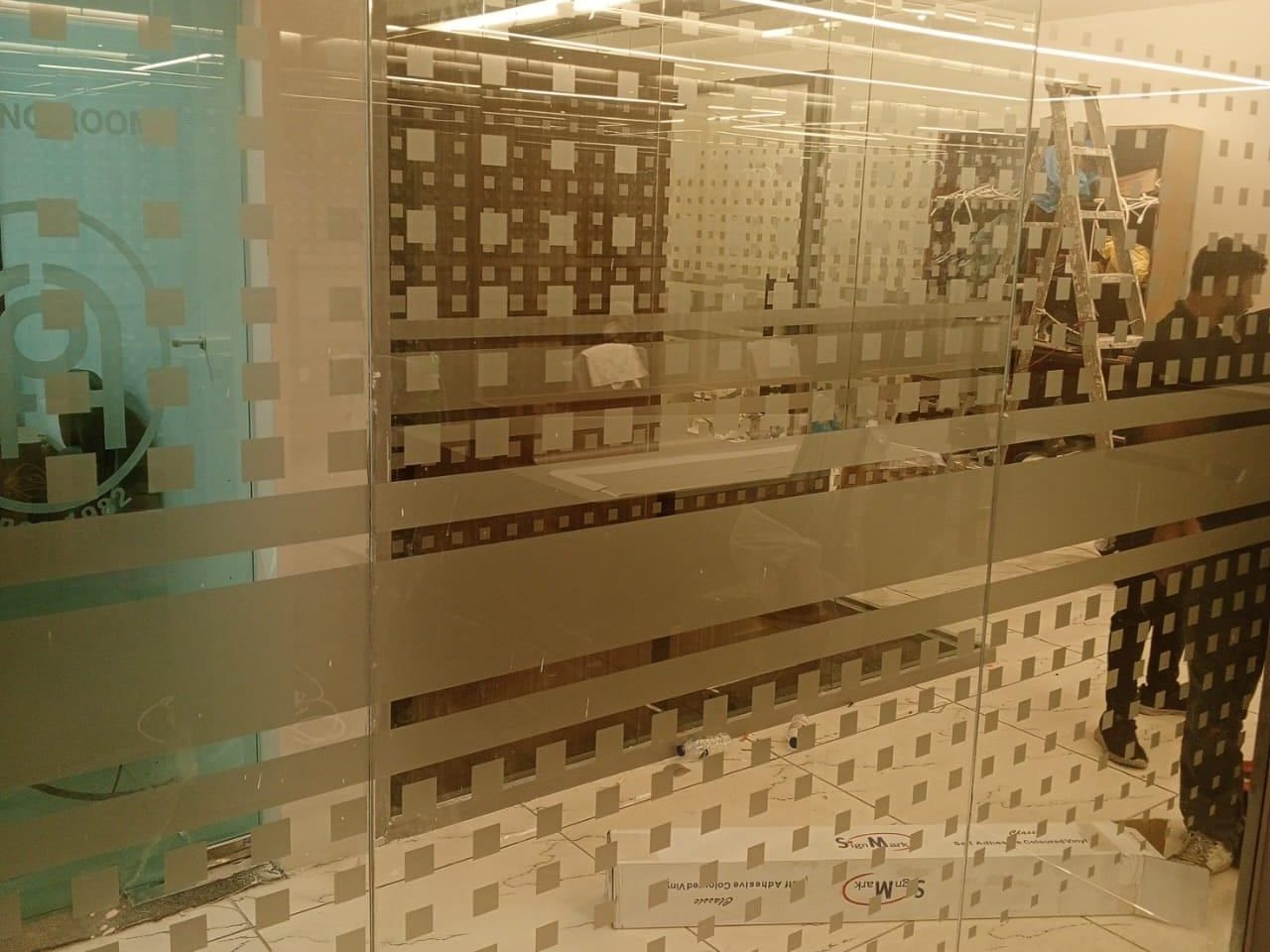
Two things frosted film will not do. It does not stop sound, so a frosted meeting room is still a glass box acoustically; that needs acoustic treatment in the room itself. And at night, when the room is lit and the corridor is darker, people outside see shadows and movement behind the frost. They will not see faces or screens, but they will know someone is there.
If someone suggests one-way mirror film for meeting rooms, think twice. It only works while the outside is brighter than the inside. In an office with a lit meeting room and a dimmer corridor, it flips, and the people inside become the ones on display.
Glass manifestation: the markings that stop people walking into glass
Manifestation is the industry term for markings on clear glass that make it visible. Floor-to-ceiling partitions are almost invisible when they are clean and well lit, and people do walk into them, especially visitors, people reading their phones and people with low vision.
What Dubai's code says. The inspection checklist in the Dubai Universal Design Code asks for two horizontal bands on glass surfaces:
- each band 100 mm high
- one band between 1,400 and 1,600 mm above the floor
- one band between 850 and 1,000 mm above the floor
- a contrast of 50 LRV (light reflectance value) against the background
UK guidance in Approved Document K uses the same two height zones. It also accepts a logo or sign at least 150 mm high, repeated along a glazed screen, or a decorative feature such as broken lines or bands at least 50 mm high. Two rows of 50 to 75 mm frosted dots are the simplest version. Many international fit-out specifications follow it, so you may see it quoted on Dubai projects too.
Why this matters for frosting. A privacy band from 900 to 1,800 mm already covers both zones, so one film can do both jobs. But it only counts if it contrasts. White frost against a white wall, or against a bright window behind the glass, can be very hard to see. In those spots, add a contrasting strip or a printed element inside the band.
Glass doors need extra thought. A glass door in a frosted partition is the panel people walk into most, because the frost on either side makes the clear door read as an open gap. Mark the door in the same zones, and where a door can be held open, make its edge visible too.
Who decides? The rules your glass must meet depend on the code your fit-out is approved under and the authority approving it: Dubai Municipality, a free zone authority, Trakhees or a master developer. Ask your fit-out consultant to confirm the marking heights and contrast in writing before you order film. An installer can apply film to a specification, but cannot certify compliance.
Plain frost, decorative frost and logo cut-outs
Plain frost is still the most popular choice, and for good reason. It looks like etched or sandblasted glass, suits any interior and does not date when you rebrand. If you are unsure, start here.
Decorative frost covers patterns cut from frosted vinyl (lines, dots, geometric and Arabic-inspired patterns), gradients, and textured films that imitate fabric or rice paper. It brings some personality to a partition without full branding.
Logo cut-outs come in two forms, and they look very different:
| Style | How it looks | Best for |
|---|---|---|
| Logo cut out of the frost (clear logo on frost) | The logo shows as clear glass inside a frosted band, and stands out when the room behind is lit | Meeting rooms and receptions where the frost is already there for privacy |
| Frosted logo on clear glass | Only the logo is frosted: subtle and elegant, but it can disappear against busy backgrounds | Glass doors, entrance screens, open partitions |
| Printed film | White or colour ink printed on clear or frosted film: holds fine detail and matches brand colours | Detailed logos, taglines, colour branding |
Know when cut vinyl is not enough. Cut frost handles bold shapes well. Very thin lines, small text and fine detail are the parts that look ragged and lift first. If your logo has a fine tagline or detailed artwork, use printed film instead. It can also match your brand colours far more closely than any coloured frost.
A placement tip. If you repeat your logo along the glass, put it in the 1,400 to 1,600 mm zone and make it at least 150 mm high. It then works as branding and as safety marking at the same time, as long as it has enough contrast.
Frosted film is usually one part of a wider office refresh. See how we combine it with wall graphics and murals and reception signs on our office branding page.
Film quality, installation and rented offices
Not all frosted film is the same. Cheaper frosted vinyls can shrink at the edges, yellow or go patchy over time; better films stay flat and even for years indoors. Ask for the brand and product name, and for the expected indoor life in writing.
What a good installation looks like:
- The installer measures on site rather than working from drawings: panels in the same room are often a few millimetres different.
- Film goes on wet, so it can be positioned and squeegeed without bubbles. It can look slightly milky for a few days while the water dries out. That is normal.
- There is a small, even gap between the film edge and the frame on every panel.
- A band running across several panels lines up exactly. If panels differ in height, the band is set from the floor, not from the bottom of each panel.
- Wide panels are planned around the roll width: frosted film commonly comes in rolls about 1.2 m or 1.5 m wide, so a 900 mm band runs without a joint, while full-height frost on a wide panel may need a neat butt joint.
Glass that needs a check first:
- Fire-rated glass. Adding film can affect a fire-rated glazing system's certification. Check with the glass supplier or your fire consultant before anything goes on it.
- External windows in direct sun. West- and south-facing glass in the UAE gets very hot, and films that absorb heat can increase thermal stress, particularly on double-glazed units. Plain white frosts are usually lower risk, but on large external glazing ask the film manufacturer to confirm the film suits that glass.
If you rent your office, frosted film has a big advantage over etched or sandblasted glass: good film comes off cleanly. Still, check three things:
- Fit-out approval. Many towers and free zones want to approve any change to partitions, including film. Ask building management before you book an installer.
- Working hours. Many buildings only allow fit-out work in the evening or at weekends.
- Removal at the end of the lease. Ask whether your installer removes film too, and roughly what it costs. Film left in the sun for years is harder to remove and can leave adhesive behind.
For shopfront and street-facing glass, where the aim is visibility rather than privacy, see our window graphics and vinyl stickers page.
Mistakes we see on office glass
- The band stops too low. A band ending at 1,500 mm looks fine from the meeting table, but anyone standing in the corridor sees straight over it.
- The glass door is left clear. The partition is frosted and the door is not, so the door reads as an open gap.
- White frost against a white background. It looks smart but can be almost invisible as a safety marking. Check the contrast against what is actually behind the glass.
- One-way mirror film in meeting rooms. It works in daylight and fails in the evening, when the lit room becomes the brighter side.
- A detailed logo in cut vinyl. Thin lines and small text lift first and look ragged; printed film handles detail far better.
- Bands that do not line up. Panels of different heights, each frosted from its own bottom edge, give a stepped band. Always set heights from the finished floor.
- Forgetting the people inside. A 900 to 1,800 mm band also blocks the view out for people sitting in the room. If the room needs a connection to the office, use a gradient or leave a clear strip at seated eye level.
Questions to ask your installer
- What film are you using? Get the brand, the product and the expected indoor life in writing.
- Will you measure on site? Quotes from drawings alone often miss panel differences and door details.
- Can we test the height first? Tape a strip of paper or a film sample to the glass at the proposed height, then sit at the table and stand in the corridor. Five minutes of this saves a lot of regret.
- Cut or printed for our logo? A good installer will tell you honestly if the logo is too detailed for cut vinyl.
- Does the band cover the safety marking zones, with enough contrast? If not, what will you add?
- Is any of our glass fire-rated or external? If so, has the film been checked for it?
- Can you work after hours, and who handles the building's permit?
- Do you remove film at the end of a lease, and roughly what does it cost?
How Bayan Branding approaches office glass
We start with a floor plan and a few photos, mark the privacy level room by room, and test the band height on the actual glass before ordering film. Logos are checked for detail before we decide between cut and printed film, and bands are set from the finished floor so they line up across every panel and door. You can see recent frosted glass, partition and logo work in our portfolio.
Planning glass for a new office or a refresh? Send us your floor plan and a few photos and we will suggest heights and film options for each room.
Get a Free QuoteFrequently asked questions
What height should frosted film be on office glass?
For meeting rooms, a band from about 900 mm to 1,800 mm above the finished floor gives privacy from people walking past, because the top edge clears standing eye level. For full privacy, frost from the floor to at least 2,000 mm.
Does frosted film make a room darker?
Only slightly. Frosted film lets most of the light through while blocking the view, so the room stays bright. Full-height frost on every wall feels more enclosed than a band.
Can people see through frosted film at night?
Not clearly. When the room is lit and the outside is darker, people outside can see shadows and movement, but not faces or screens.
Does frosted film count as glass manifestation?
It can, if it covers the 850 to 1,000 mm and 1,400 to 1,600 mm zones and contrasts with the background. Dubai's Universal Design Code checklist asks for a 50 LRV contrast, so confirm the requirement for your building with your fit-out consultant.
Can frosted film be removed?
Yes. Good-quality film peels off and the glass is cleaned, which makes it a better choice than etching or sandblasting for rented offices and for brands that may change.
Can I put my logo on frosted film?
Yes. You can cut the logo out of the frost so it shows as clear glass, frost the logo on clear glass, or print it in colour on film. Detailed logos and fine text are better printed than cut.
Is frosted film soundproof?
No. It only affects what people can see. Acoustic privacy needs acoustic treatment in the room itself.
How long does frosted film installation take?
It depends on the amount of glass and on access, but a few meeting rooms are usually done in a single visit. Many buildings require the work to happen after hours.
Sources
- Dubai Universal Design Code: inspection checklist for doors, windows and glass surfaces, Trakhees
- Glass manifestation (Approved Documents K and M), Designing Buildings Wiki
- Glass manifestation compliance guidance note, 2025, British Sign and Graphics Association
Reviewed 7 November 2026. Privacy heights are rules of thumb based on typical adult eye levels; confirm safety marking requirements for your building with your fit-out consultant or the approving authority.